
Table of Contents

The UEFA Women’s Champions League (UWCL) semi-final round ended with the two names not everyone would have expected. With the run that Arsenal had been on, it seemed that it would have been a repeat of last year’s final in Lisbon. However, record holders Lyon said: ‘not this time’.
Barcelona and Lyon are heading to Oslo for another final again, continuing a rivalry that increasingly feels like one of the most defining stories of modern women’s football. On the surface, it all looks predictable. Europe’s two giants survive. The established powers remain standing.
It was, however, quite different. Neither Arsenal nor Bayern Munich disappeared quietly. Both had moments where the ties genuinely tilted in their favour. They exposed vulnerability in teams that often seem untouchable. Unfortunately, both walked away carrying the kind of disappointment that only comes when players truly believe they belonged there too.
That may have been the most striking thing about these semi-finals. The gap is still there. But it no longer feels impossible.
Arsenal leave Lyon wondering about the margins again
For a brief stretch in the second half in France, Arsenal looked like they were about to drag another impossible European night into existence.
That feeling inside the game changed quickly and almost unexpectedly.
Arsenal arrived in Lyon protecting a narrow first leg lead after Olivia Smith’s late winner at the Emirates had transformed the tie days earlier. There was belief around the squad too. Under Renée Slegers, Arsenal have slowly developed an emotional resilience that has completely changed the feeling around this team over the last year.
The problem was that Lyon responded like they always seem to in Europe.
From the opening minutes, the intensity felt different from the first leg. Melchie Dumornay played with frightening aggression, constantly driving directly at Arsenal’s midfield and back line. Selma Bacha’s return added width and urgency. Suddenly Arsenal had to defend deeper than they probably wanted to, spending more energy surviving moments rather than controlling them.
Even then, the tie still felt oddly balanced.
Embed from Getty Images
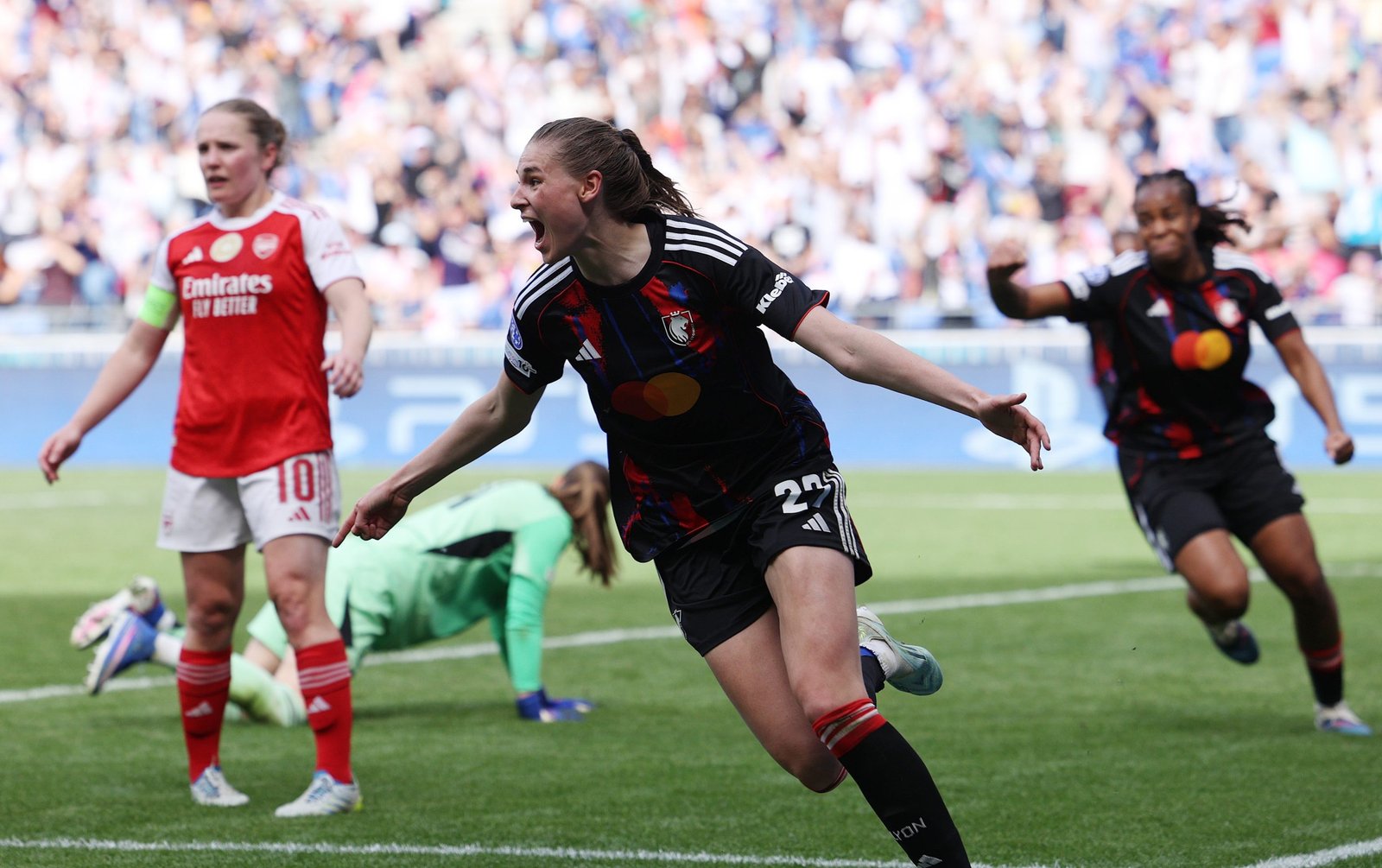
The retaken Wendie Renard penalty changed the emotional flow of the match more than the scoreline itself. Arsenal looked rattled afterwards in a way they rarely have under Slegers. Passes became rushed. Defensive distances stretched thin. Lyon sensed vulnerability and Kadidiatou Diani’s goal before half-time suddenly left Arsenal chasing for a spot in the final.
That first half probably decided everything. What stood out again was Arsenal refusing to disappear.
A few years ago, this may have become one of those European nights where Arsenal slowly faded under pressure. This version of the team no longer behaves like that. Alessia Russo’s second half goal completely shifted the atmosphere again. Lyon became nervous. Arsenal started pressing higher. For a few minutes, extra time seemed within reach.
Then came the cruelest part of elite football.
Jule Brand’s late winner did not feel dramatic in a cinematic sense. It felt deflating. One of those moments where the emotional energy simply drains out of a team all at once. Arsenal had spent so much of the evening trying to climb back emotionally that the final blow felt heavier than the scoreline itself.
Embed from Getty Images
Afterwards, Slegers spoke about pride but also about wanting more. That tension probably explains where Arsenal are now as a club.
There was a time when reaching a Champions League semi-final would have been celebrated almost unconditionally. Now it hurts because expectations have shifted entirely. Arsenal no longer arrive at these stages hoping to compete respectfully with Europe’s elite. They arrive expecting to win.
There is also something important about how close Arsenal suddenly feel to this level again. The new Arsenal is emotionally stronger, tactically clearer and far less intimidated by these occasions than previous versions of the team. The grace with which they handled the loss had to be commended.
The frustration comes from how real the opportunity looked.
Barcelona and Alexia Putellas keep making pressure look survivable
If Arsenal’s semi-final felt emotionally exhausting, Barcelona’s felt strangely inevitable by the end.
Bayern probably caused Barcelona more discomfort than many expected across the two legs. That somehow almost forced Barcelona to be more impressive.
Embed from Getty Images
There was a period early in the second leg where Bayern destabilised the match. Linda Dallmann’s equaliser after Salma Paralluelo’s opener briefly changed the atmosphere. Barcelona misplaced passes. Bayern won duels across midfield. Pernille Harder started finding spaces between the lines and the game looked like it leaned towards emotions rather than control, especially at a sold out Camp Nou, again.
That is usually where chaos begins against Barcelona. Instead, Barca slowed everything down again.
It is becoming difficult to describe Alexia’s influence purely through goals or statistics now, even though she continues producing both at extraordinary levels. Against Bayern, her first goal before half-time felt less like a finish and more like emotional management. Barcelona stopped rushing immediately afterwards. Bayern’s momentum softened. The game returned to Barcelona’s rhythm.
That ability may ultimately become one of the defining reasons Putellas will be remembered among the very greatest players the sport has ever produced.
Embed from Getty Images
There are footballers who dominate physically. Others overwhelm games with pace or relentless creativity. Alexia controls emotional tempo. She seems to understand exactly when Barcelona need calmness and when they need authority.
The second half eventually became too much for Bayern to contain. Ewa Pajor stretched the lead before Alexia struck again, continuing what has quietly become one of the best runs of form in Europe this season and what may almost certainly guarantee her that third Ballon d’Or. Bayern kept fighting through Harder and Klara Bühl but Barcelona never fully lost emotional control again once Alexia settled the game.
That is the difference.
Bayern looked good enough to compete physically and tactically. Barcelona looked better at surviving pressure psychologically.
Still, Bayern leave this semi-final with evidence that they belong here. Under Barcala, there is a maturity and belief developing within this squad that feels sustainable rather than temporary.
Embed from Getty Images
Oslo now feels bigger than just another final
Now, Europe arrives at the matchup many quietly expected all along. Lyon against Barcelona… again.
These semi-finals probably changed the feeling around both finalists slightly. Lyon looked vulnerable at times against Arsenal. Barcelona looked uncomfortable at times against Bayern. Neither side will arrive in Oslo looking more untouchable than the other.
That makes the final more interesting.
The game no longer feels like a meeting between a historic power and a rising dynasty. It feels like two football empires trying to protect their place at the top while the rest of Europe edges closer every season.
The margins are shrinking.
Which is why the defeats hurt Arsenal and Bayern so much more than they might have a few years ago. Because they were close enough to fully imagine themselves in the final.
Sadly, that is usually the hardest kind of Champions League loss to live with.
Related articles from Her Football Hub:
- UWCL semi-finals: Advantage Arsenal over Lyon, Bayern and Barcelona remain on a knife edge
- Esmee Brugts: ‘There’s a lot of pressure on Barcelona’ in UWCL mission
- Bethany England to leave Tottenham Hotspur in long list of departures

