

While soccer’s calendar offers few moments of respite, the World Cup doubles as a time for referendums on the legacies of great players. Lionel Messi, Luka Modrić and Cristiano Ronaldo approach this summer’s tournament expecting it to be their final turn on their sport’s biggest stage. Kevin De Bruyne and Casemiro could clarify their complicated international careers in North America; Neymar may not get the same chance.
Missing a sendoff like this may be a bit more relatable to the life that we mortals endure. Indeed, there’s no crueler way for an international career to end than tripping at the final hurdle of World Cup qualification.
The United States’ failure to get a draw against Trinidad and Tobago in 2017 doubled as the final international match for three of the program’s best players: DaMarcus Beasley, Clint Dempsey and Tim Howard. So painful was the sight of Gianluigi Buffon’s tear-stained cheeks after Italy’s unexpected flop in 2018 that theAzzurri brought him out of international retirement for one final friendly four months later.
Related: ‘It’s not finished’: Lamine Yamal pledges Barcelona will fight to the end
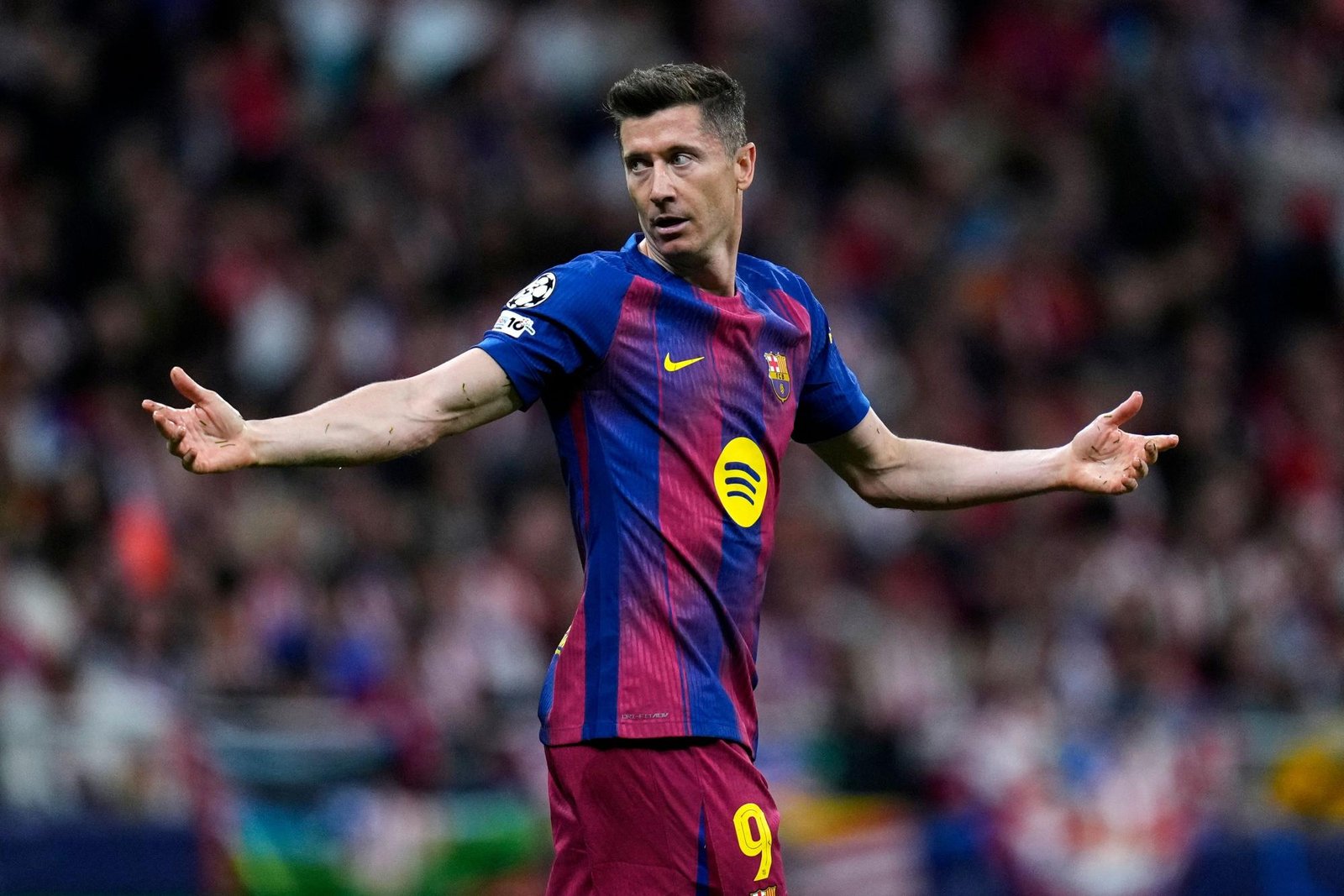
Then there’s the recent misery endured by Robert Lewandowski. OK, maybe not so miserable: he collects a reported €400,000 a week at Barcelona. But the spring of 2026 provided the Poland striker with a chance to complete his impressive CV with a second continental title and leading Poland’s first run beyond a World Cup round of 16 since 1982. Instead, a pair of disappointments have expedited unwanted questions about the 37-year-old’s future.
There will not be a second Champions League title for the Pole, after Barcelona’s quarter-final exit to Atlético Madrid. Nor will he help Fifa’s marketing push at this World Cup. What was poised to be a possible legacy-refining stretch has abruptly ended before it began.
Poland aren’t one of world football’s great powers. Their postwar World Cup record of qualification comes in three blips: from 1974 through 1986, including a pair of third-place showings starring Grzegorz Lato; then 2002 and 2006 thanks to a gritty defensive core and great goalkeepers; and, thanks to Lewandowski and others, 2018 and 2022.
To say those tournaments didn’t meet expectations for one of the era’s greatest forwards is an understatement. Poland fell in the 2018 group stage, with Lewandowski held scoreless, and barely escaped their group in Qatar before France blew past them in the round of 16. Lewandowski’s second World Cup goal, a last-second consolation penalty against Les Bleus, was soon followed by questions of whether he’d played his final World Cup.
After their star threatened to retire midway through qualifying for this World Cup, Poland changed their coach. Lewandowski returned and led them to a playoff final against Sweden. But the Swedes advanced thanks to a Viktor Gyökeres hero turn that, on another day, could have belonged to Lewandowski.
“It’s hard to say anything after a game like this,” Lewandowski mused as Sweden partied on the pitch. “I don’t know if the words I find would reflect how we feel. Soccer can be cruel.”
So, no World Cup for Lewandowski then, though his relationship with Poland had been fraught since they were knocked out of the group stage at Euro 2024. He wasted little time in hinting that he has played his final international match, returning to Barcelona with full focus on the Champions League.
Four months from his 38th birthday, Lewandowski has played a rotational role for the first time since his debut season at Dortmund, when he was fresh in Jürgen Klopp’s locker room after two stellar years at Lech Poznań.
He’s still scoring goals, of course. He’s got a dozen in La Liga and 17 in all competitions this season, including a brace against Newcastle that delighted his manager. And yet, with Barcelona down a goal and a man against Atléti in the first leg of the Champions League quarter-final, Lewandowski was sacrificed as Hansi Flick recalibrated for the second half. A week later, needing a goal to force extra-time in the second leg, Lewandowski didn’t check in until the 68th minute, enough time for a single shot and little more.
At this stage, Barcelona’s grip on the La Liga title is fairly firm. But league titles do little for Lewandowski these days: he won one at Lech, two in Dortmund, eight in a row at Bayern and a pair already at Barcelona. Even if they see out this year’s La Liga campaign, a 14th league title does little for his legacy that his first 13 haven’t already.
His Barcelona future is a little more opaque than for Poland, albeit only just. His contract is up at season’s end, and reports suggest he’d have to take a hefty cut to stick around Catalonia. Even then, will a chronic goalscorer be satisfied with a backup striker’s minutes? Surely, it’s all Barcelona may offer him in his career’s latter stages.
“We still have some time,”Lewandowski told a reporter late last week. “The club knows what I think, and I’ve had time to think,” he said. “I don’t want to talk about offers and my future. The remaining matches and the goals are more important.”
Much as with other gilded peers of Lewandowski nearing the end of their playing careers, MLS and the Saudi Pro League are brought up as next steps. Thomas Müller and Bastian Schweinsteiger have enjoyed life in North America, while Kingsley Coman and Karim Benzema cash handsome checks in Saudi Arabia. And yet, neither league offers the same legacy-cementing aura that a second Champions League or a deep World Cup run would have for one of the greatest strikers the game has ever seen.
“Soccer can be cruel,” indeed. A marvel of his profession, now without an obvious final act to cement his legacy.

