
Table of Contents


Image via TNT FC
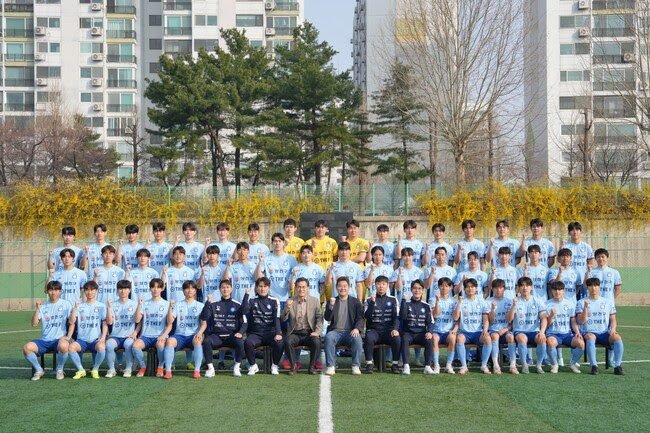
TNT FC has quietly built a reputation as a launchpad for overlooked players. Korean media has described the club as everything from a “pro player factory” to a “second-chance platform.” The numbers back it up: Over 250 players have come through TNT FC and gone on to sign for semi-pro or professional teams. This isn't limited to teams in Korea, nor is it limited to teams in Asia. In 2026 alone, there have been 18.
What makes Yangcheon TNT FC so special? TNT FC CEO Kim Tae-ryung, speaking to K League United's K League Conversations Podcast earlier this year spoke in detail about the club and what makes it unique.
"This was not planned from the beginning. Over the past 20 years, we have rapidly adapted to changes in the Korean football ecosystem. Thanks to this, we have maintained our status as a representative club of the Korean amateur category for nearly two decades. We have developed through numerous trials and errors, really so many errors in our club history. We evolved from an amateur team to a football club and from a football club to an independent football club. And now from an independent club to a division club, we begin to formulate concrete plans for semi-professional and eventually professional status, starting from the time that KFA launched its division system in 2017, I think. With the signing of an official agreement with Yangcheon-gu and the attraction of various sponsorships, we have been preparing for the future very seriously since 2020."
"Our football club [is] where people grow. This is one of our club's core messages. TNT has promoted 255 players to the professional and semi-professional stage. For example, Han Ka-ram, the vice captain of FC Anyang, Kim Seung-geon, the goalie of Hwaseong FC, and we also promoted a player to J.League 1, Kim Moon-hyeon (Avispa Fukuoka). These players are representative players who came from TNT. There are several coaches as well as players. Mario Lemos, now he's working in the Indonesian first division. And Kim Geun-cheol, who was recently appointed as the assistant coach of the under-20 national team.
"While results and competitiveness are important, our identity lies in growth. That's the main. So even one day, if we advance to the K4 for next season, this philosophy will not change. So we discover natural, future stars. This is our goal."
What makes TNT FC unique is not just its success rate, but the system behind it. Rather than relying on a single pathway, the club operates through a combination of methods that collectively reshape how players can enter the professional game.
There are different ways that TNT sends players into the professional game, but essentially, at the heart of TNT FC is a simple but powerful idea: talent does not disappear just because a player misses the traditional pipeline.
The Second-Chance Recruitment Model
TNT FC actively recruits players who have been released from youth academies, failed to secure K League draft selection, or seen their careers stalled by injury or circumstance.
In Korea’s rigid football structure, these players are often filtered out permanently but TNT instead treats them as unfinished prospects. This approach reframes failure. Rather than a dead end, it becomes a detour and one that TNT is specifically designed to navigate.
The best example of this is perhaps the very first, the prototype. Park Jung-hoon was a former K League first-round draft pick with Jeonbuk, but his career was derailed by injury. In 2014, he joined TNT to rebuild his fitness and form and later signed with Bucheon FC 1995 in K League 2. Park was TNT's first success story and helped create the club's identity as a comeback platform.
In terms of players moving overseas, Lee Jeong-geun was on the books of Busan IPark but was released. He joined TNT to keep training and for exposure, and was recommended to the Thai club Police Tero. This is classic TNT – player fails domestically, is marketed abroad, and enjoys a successful career outside of Korea.
Professional Environment Without Professional Status
TNT FC operates more like a professional setup than a casual club. Players train in a structured, high-intensity environment designed to maintain match fitness, replicate professional tactical systems, and prepare players for immediate integration into pro squads.
This is critical. Many free agent players struggle not because of lack of talent, but because they fall out of competitive rhythm. TNT eliminates that gap. In effect, the club functions as a holding space where players remain “match-ready” while seeking opportunities – a detail that significantly increases their attractiveness to scouts.
Constant Exposure Through Trials and Showcases
One of TNT’s most distinctive features is its relentless focus on visibility. The club regularly organizes trial matches against professional and semi-pro teams, invites scouts to observe training sessions and games, and sends players to domestic and international tryouts
Instead of waiting for scouts to discover players, TNT actively puts players in front of decision-makers. This flips the traditional dynamic. Players are no longer passive participants in a closed system; instead, they are continuously marketed, evaluated, and repositioned for opportunities.
Acting as an Informal Agency Network
Beyond coaching and competition, TNT FC effectively operates as a bridge between players and the market. The club leverages relationships with K League teams, connections in Japan (J-League and lower divisions), and links to Southeast Asian and lower European leagues.
This network allows TNT to place players in a wide range of destinations, not just within Korea’s tightly contested domestic system.
For many players, especially those overlooked at home, this international angle is decisive. A contract in Japan or Thailand can restart a career that might otherwise have ended.
Global Pathway Mindset
While initially seen as a “last chance” team, TNT has evolved into something more forward-looking: a global pathway platform. Rather than treating the K League as the only destination, the club embraces a broader view of professional football: J.League as a parallel career track, Southeast Asia as a growth market, and lower-tier European leagues as entry points
This flexibility dramatically expands the number of viable opportunities for players. It also reflects a shift in mindset. Success is no longer defined solely by making it into Korea’s top division, but by sustaining a professional career anywhere in the global football ecosystem.
Volume as a Strategy
Another key to TNT’s impact is scale. Instead of focusing on a small, elite group, the club works with a large pool of players. This increases the probability of successful placements and the diversity of pathways (different leagues, levels, countries).
Korean media often highlights the sheer number of players who move on from TNT each year. That volume is not incidental – it’s part of the model. By creating a high-throughput system, TNT turns what is usually a rare outcome into a repeatable process.
Narrative and Motivation
TNT’s identity plays a subtle but important role. The club is often compared to “second-chance” narratives popular in Korean media – stories of players rebuilding careers after setbacks. This framing attracts highly motivated individuals and fosters a culture of urgency and resilience
Players are not just training; they are trying to reclaim or redefine their careers. That psychological edge can make a tangible difference in performance and persistence.

