
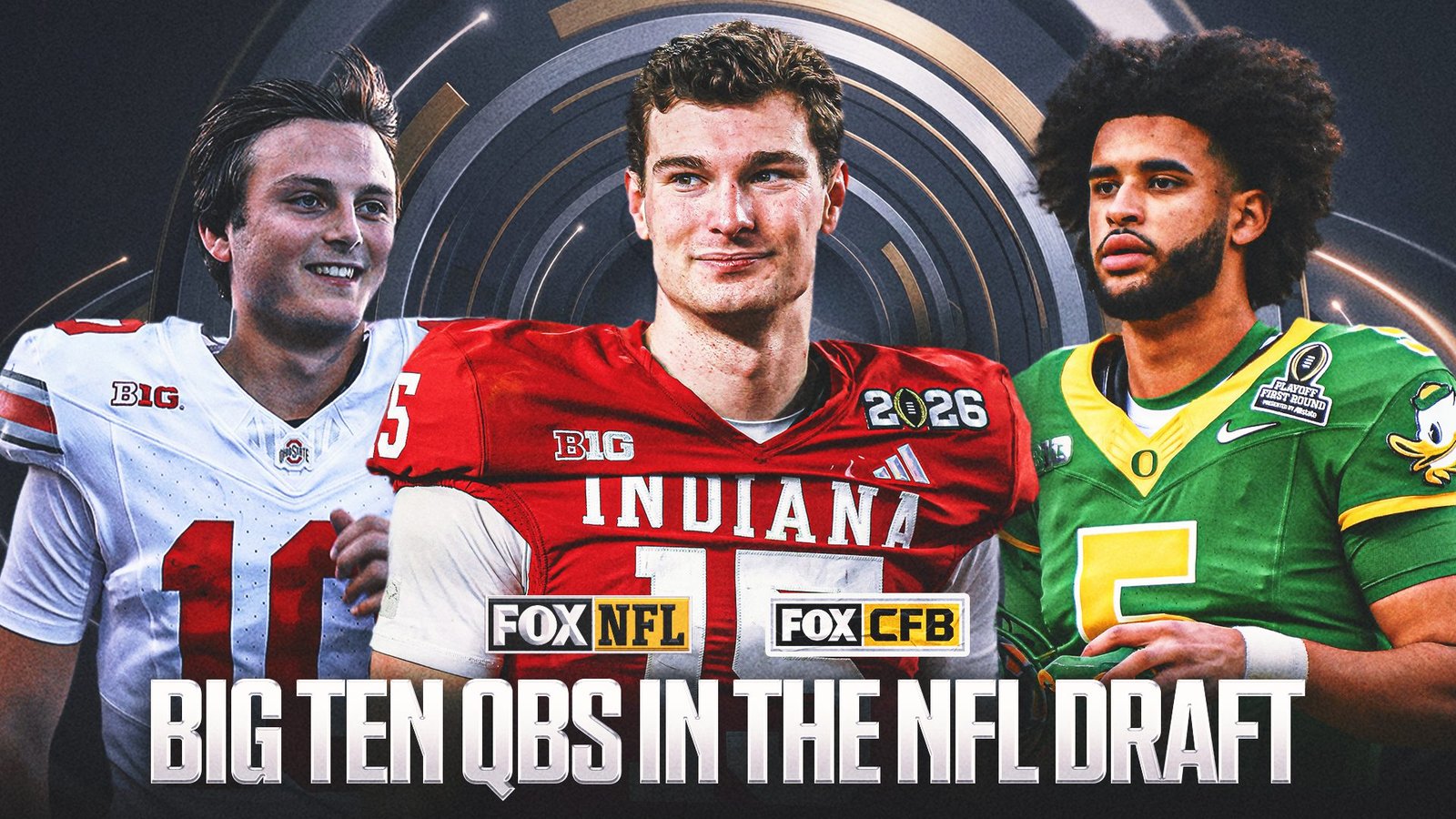
How the Big Ten Could Enter a Golden Era for NFL Draft QBs
For nearly two decades, from 2006-22, college football followed a familiar script: Each January, a team from south of the Mason-Dixon Line celebrated a national championship amid falling confetti. Three months later, in late April, a player from that same region crossed the stage and shook hands with the commissioner as the No. 1 pick in the NFL Draft.
Sometimes, in the case of former Auburn quarterback Cam Newton and former LSU quarterback Joe Burrow, the circles in those two Venn diagrams overlapped. Football down South, people often said, just means more.
And yet, just a few years removed from that prolonged period of southern dominance, a new pattern is beginning to take hold atop the sport that nobody can ignore.
Three consecutive national championships have been won by Big Ten programs, all of them based in northern locales. And last week, when the Las Vegas Raiders selected Indiana's Fernando Mendoza with the No. 1 overall pick, making him their new franchise centerpiece, he finally papered over a statistic that listed Illinois quarterback Jeff George as the last Big Ten signal-caller to be drafted that high — way back in 1990.
A day after Mendoza officially became a pro, Penn State quarterback Drew Allar was drafted in the third round by the Pittsburgh Steelers. On Saturday, the Washington Commanders selected Rutgers quarterback Athan Kaliakmanis in the seventh round. Just like that, the Big Ten had three or more signal-callers drafted for only the fourth time in the last 22 years.
"It's the hardest position to evaluate," Raiders general manager John Spytek said at the NFL Scouting Combine in February. "So much is required of those guys. Trying to have a vision for how they played and whatever offense they were asked to run in college and how they're going to fit into ours, and then how they're going to handle the pressure that comes with being one of 32 in the world is a lot. There's a lot that goes into it."
Fernando Mendoza is selected with the first overall pick by the Las Vegas Raiders in the 2026 NFL Draft. (Photo by Jason Miller/Getty Images)
Back in 2016, five of the league's quarterbacks heard their names called in the draft: Christian Hackenburg from Penn State, Connor Cook from Michigan State, Cardale Jones from Ohio State, Nate Sudfeld from Indiana and Jake Rudock from Michigan, all of whom busted. What's happening now, though, feels much different, especially when considering the potential avalanche of Big Ten quarterbacks that might litter the 2027 draft.
The dollar-driven cocktail of NIL, revenue sharing and the transfer portal has transformed the Big Ten into a much more attractive, and viable, option for high-level quarterbacks. All three signal-callers who led their respective schools to national championships in recent years — J.J. McCarthy at Michigan, Will Howard at Ohio State, Mendoza at Indiana — were highly compensated players who went on to be drafted within months of hoisting a trophy on the grandest stage. Allar was the only QB of this year's Big Ten crop who started and ended his collegiate career at the same program, which reflects the league's wide-ranging attractiveness in the portal.
To put it simply: In an era when Big Ten football is booming like never before, the conference is approaching new heights at the sport's most important, most influential position.
Drew Allar during the 2026 NFL Scouting Combine. (Photo by Stacy Revere/Getty Images)
Even though the Big Ten fell short of its recent high-water mark for quarterbacks selected in a single draft — some experts believed Illinois' Luke Altmyer and Iowa's Mark Gronowski might have snuck into the seventh round — there's a strong chance the number reached in 2016 will be matched or exceeded next April. The upcoming season in the Big Ten should be an exceptional one for quarterback play, particularly among conference front-runners, and it's not unreasonable to think as many as eight signal-callers could factor into draft discussions.
The 2027 crop includes two potential candidates for the top pick: Julian Sayin from Ohio State and Dante Moore from Oregon. Both players have enough remaining eligibility to bypass the draft and remain in school beyond this season, but they both flashed enough requisite poise and arm talent during standout campaigns last fall to garner widespread attention from NFL evaluators.
[2027 MOCK DRAFT: Five QBs Land In First Round]
Oregon quarterback Dante Moore (Photo by Jeff Robinson/Icon Sportswire via Getty Images)
While guiding their respective teams to College Football Playoff berths, Sayin and Moore finished first and fourth, respectively, in the national rankings for completion percentage last season. Miami's Carson Beck and Mendoza were the two players sandwiched between them. It's fair to assume both should improve their stock in 2026, which will include plenty of Heisman talk and NFL Draft chatter alike.
"I don't think you can ever have too many quarterbacks," Miami Dolphins general manager Jon-Eric Sullivan said at the NFL Scouting Combine in February. "I think that the value of the position cannot be overstated. I think that you have to infuse as much competition into that room every year [as] you possibly can."
Even the general idea that the Big Ten could produce first-round quarterbacks in consecutive years is rare, given the league's longstanding reputation for ruggedness between the tackles. The possibility of the conference generating back-to-back No. 1 overall picks at that position? Practically unheard of.
In 1986, Jim Everett from Purdue and Chuck Long from Iowa were both selected in the first round of the NFL Draft. Michigan standout Jim Harbaugh matched them as an opening-round pick the following year. From that point forward, however, nearly 40 drafts would come and go before the Big Ten could finally enjoy something like that again.
The drought was finally broken when the Minnesota Vikings selected former Michigan quarterback J.J. McCarthy at No. 10 overall in 2024, one year after the Houston Texans took former Ohio State quarterback C.J. Stroud at No. 2 overall.
C.J. Stroud shakes hands with Roger Goodell after the Texans selected him in the first round of the 2023 NFL Draft. (Photo by Scott Winters/Icon Sportswire via Getty Images)
Only four Big Ten quarterbacks have developed into first-round picks across the last 30 years: McCarthy, Stroud and former Ohio State standouts Justin Fields (2021) and Dwayne Haskins (2019). Prior to that, there was a 24-year gap between Haskins and conference predecessor Kerry Collins from Penn State, which hasn’t seen a quarterback drafted in the first round since. Any chance of Allar, a former five-star recruit, snapping that streak and giving the Big Ten multiple first-round quarterbacks for the first time since 1986 quickly evaporated the moment he broke his ankle in October.
Such an outcome is unlikely to be repeated next spring, when Sayin and Moore seem like surefire first-rounders should they choose to enter the draft. They’ll be flanked by a host of other ex-transfer, draft-worthy quarterbacks: Jayden Maiva from USC, Nico Iamaleava from UCLA, Josh Hoover from Indiana, Rocco Becht from Penn State and Aidan Chiles from Northwestern.
Strong seasons this fall could vault one or two of those players into early-round conversations next spring, the same way Mendoza's stock surged throughout a record-setting season for the Hoosiers. Mendoza set a new standard when his name was called last week, and the Big Ten will be hoping that it's merely the beginning.

