

Sporting directors live in the mid-to-long-term. While the coaches they hire and players they recruit have to deal with the highs and lows of week-to-week performance reviews, the executives watch on and make sure the project hasn’t veered off course. With a club, the rule of thumb is that it can take at least three transfer windows to start seeing tangible evidence of progress under a new sporting director. In international soccer, it often takes multiple cycles.
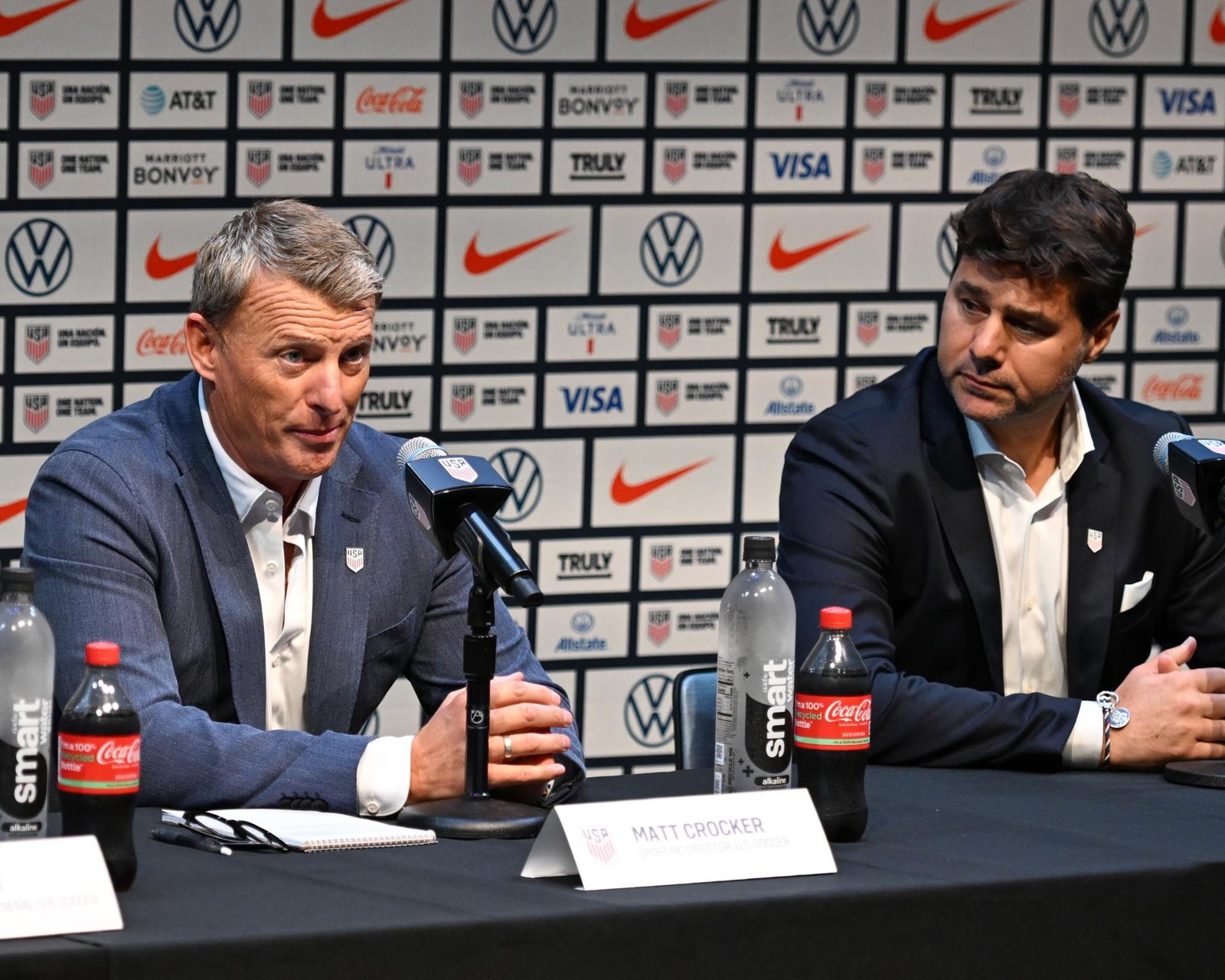
Matt Crocker arrived at US Soccer in April 2023 pledging to guide the program into a brave new era while acknowledging that initiative would take time to actualize. As it turned out, he never game himself that time. US Soccer announced on Tuesday that Crocker was stepping down as sporting director, and he’s reportedly due to take up a similar position with Saudi Arabia.
Related: Can the USMNT and USWNT become ‘America’s favorite sports teams’? Their CEO thinks so
Because of that long-term thinking, evidence of immediate returns on his seven-figure salaried position with the US is therefore scarce.
Crocker’s first headline task was to determine whether to keep Gregg Berhalter for a second cycle as USMNT boss after the team’s round of 16 exit in Qatar. Berhalter had already been out of the job for four months, his contract having ended at the previous cycle’s culmination. Even as his decision to speak about a tense dynamic at the World Cup around Gio Reyna’s playing time was investigated by the federation, Berhalter remained in contention to return. Alternatives included Jesse Marsch and Patrick Vieira.
While critics already worried the process was dragging on too long, with interim boss BJ Callaghan leading the team at the 2023 Gold Cup, Crocker swore this would be a meticulous process, “really comprehensive and evidence-based” stuff. So when this metric-driven Magic 8 Ball said “just hire him back,” Crocker’s methods were an immediate cause for concern.
Those concerns proved to be well founded. The US men’s team never returned to the good vibes and collective focus on, as Berhalter said, “[changing] the way the world looks at American soccer,” and Berhalter was sacked after the US got grouped at a home Copa América. Seven wasted months to start the 2026 cycle had now bloviated to 19, dating back to that World Cup defeat against the Netherlands. By nearly any definition, the process that brought Berhalter back but afforded minimal margin for error was faulty at best and failed at worst.
Crocker’s next pick, Mauricio Pochettino, had big-name pedigree at the club level – more so than any other US coach in history. But this would be Pochettino’s first international job. Coaching clubs and countries have never had such disparate job descriptions, mostly due to the advancements in how clubs operate at the highest levels. The wisdom of that appointment won’t face an ultimate pass/fail verdict until the US exit the World Cup, and it will depend almost entirely on at what stage that happens.
Related: USMNT World Cup squad predictions: how we see the 26 for 2026
For now, momentum is scarce. In the last two friendlies before the World Cup squad is named, Pochettino’s side didn’t just lose big twice, the Argentinian seemed to go back on past lessons. Then again, how could he have been expected to do so on such a brisk timeline after over a decade at some of the world’s richest clubs?
On the flipside, Crocker made no mistake with his pick to replace USWNT coach Vlatko Andonovski. The women’s program was at at a relative nadir at that time in 2023, coming off a round of 16 exit in Australia and New Zealand that was the worst World Cup showing in their history.
The timing, too, couldn’t have been better. Emma Hayes was finally ready to leave Chelsea after a transformative decade-plus in charge, and she swiftly brought USWNT’s swagger back, leaning on a largely inherited core to win gold at the 2024 Olympics. From there, her team have gone from strength to strength as Hayes evaluates the depth of her player pool. Today, the USWNT are back among the favorites to win next summer’s Women’s World Cup in Brazil.
To Crocker’s credit, Hayes was empowered enough to hatch the WNT Way to finally center women in how their own sport operates. Rather than copying over cues from the men’s branch and operating identically, she’s helped pioneer a new normal that accounts for differences between women’s and men’s athletes.
Crocker had his own broader project upon being appointed: the US Way, a plan to help the country become a global soccer power. Like any good slide deck, the method was divided into three categories: pathways, infrastructure, and player development.
For much of the 2010s, the country’s youth and non-professional levels often voiced displeasure with the federation, feeling both distance and indifference from the governing body. Some of Crocker’s initiatives have already taken root. His talent ID camps, created to better survey the young talent across a sprawling nation, also allow for coaches of all levels to congregate and touch base with the federation. Coach education seems more accessible than ever, including plenty of free resources through the federation website.
There’s more to be done following Crocker’s surprise exit. The federation website has a tracker for its pathways strategy, not dissimilar to what you’d see if you’ve placed a Domino’s order. It is still at step four of seven, projected to conclude in 2028.
It can’t be overlooked that US Soccer has better financially backed Crocker than his predecessor, Earnie Stewart, or past sporting leadership of a more committee-led nature. Hayes arrived on a deal that made her the world’s highest-paid female coach. According to the federation’s latest tax filings, Pochettino took home over $5m for seven months of work in the fiscal year ending 31 March 2025, aided in no small part by billionaire donor Ken Griffin. The soon-to-open national training center was constructed with an estimated cost nearing $250m, helped by another billionaire, Arthur Blank.
And, now, Crocker leaves for Saudi Arabia: one of the few programs pumping even more money than the US into their soccer machine in hopes of building a contender.
During the March window, Crocker (along with CEO JT Batson) led a hoard of journalists on a tour of that national training center in Fayetteville, Georgia. After over an hour of winding through the sprawling complex, the final stop was at the indoor fieldhouse, which Crocker quipped will be available for all kinds of games, including staff kickarounds after (or during) the day’s work.
If Crocker plays in these pickup contests, he’ll have to do so as a distinguished guest. Perhaps his next employers will foot the bill.

