
Table of Contents

José C. Pérez can be found on social media here, and if you’re hungry for more, find their excellent work here.
The big question hovering over Real Sociedad’s 2025-26 season was whether the club’s successful project, launched in 2018 under Roberto Olabe and Imanol Alguacil, could survive the departure of its two architects. This past weekend, La Real answered with a resounding “yes” by clinching its fourth Copa del Rey title, effectively proving that despite a bumpy road, the club’s march continues.
At the season’s start, returning to European spots and reaching the Copa del Rey semi-finals would have been considered a success for what was expected to be a turbulent transition. Instead, the club has exceeded those expectations.
Last summer, Real Sociedad signalled a commitment to continuity by replacing Alguacil and Olabe with internal hires: youth coach Sergio Francisco and Head of Scouting Erik Bretos. While this move kept front-office operations stable, the team on the pitch required a stronger push than Sergio Francisco could provide.
The Fall of Sergio Francisco
Once again facing, La Real several personnel issues that had been haunting them for years: the gradual loss of controlling midfielders and key defenders, as well as their longstanding struggles to find productive forwards. The transfers did not generate much optimism. Goncalo Guedes, Carlos Soler, and Duje Caleta-Car were all once very promising young players who did not fully deliver on that promise. Yangel Herrera seemed like the best midfield solution for the team, but he spent much of the year sidelined with muscle injuries.
The pessimism was also reflected on the pitch. Sergio Francisco attempted to adopt a more direct style, a logical move given the absence of tempo controllers like Martin Zubimendi or David Silva. However, his side struggled with the physical demands of this style and failed to convert possessions into shots and goals. After a dismal run of just four wins in sixteen matches, management made the call to part ways following a loss to Girona in December.
The Rise of Matarazzo
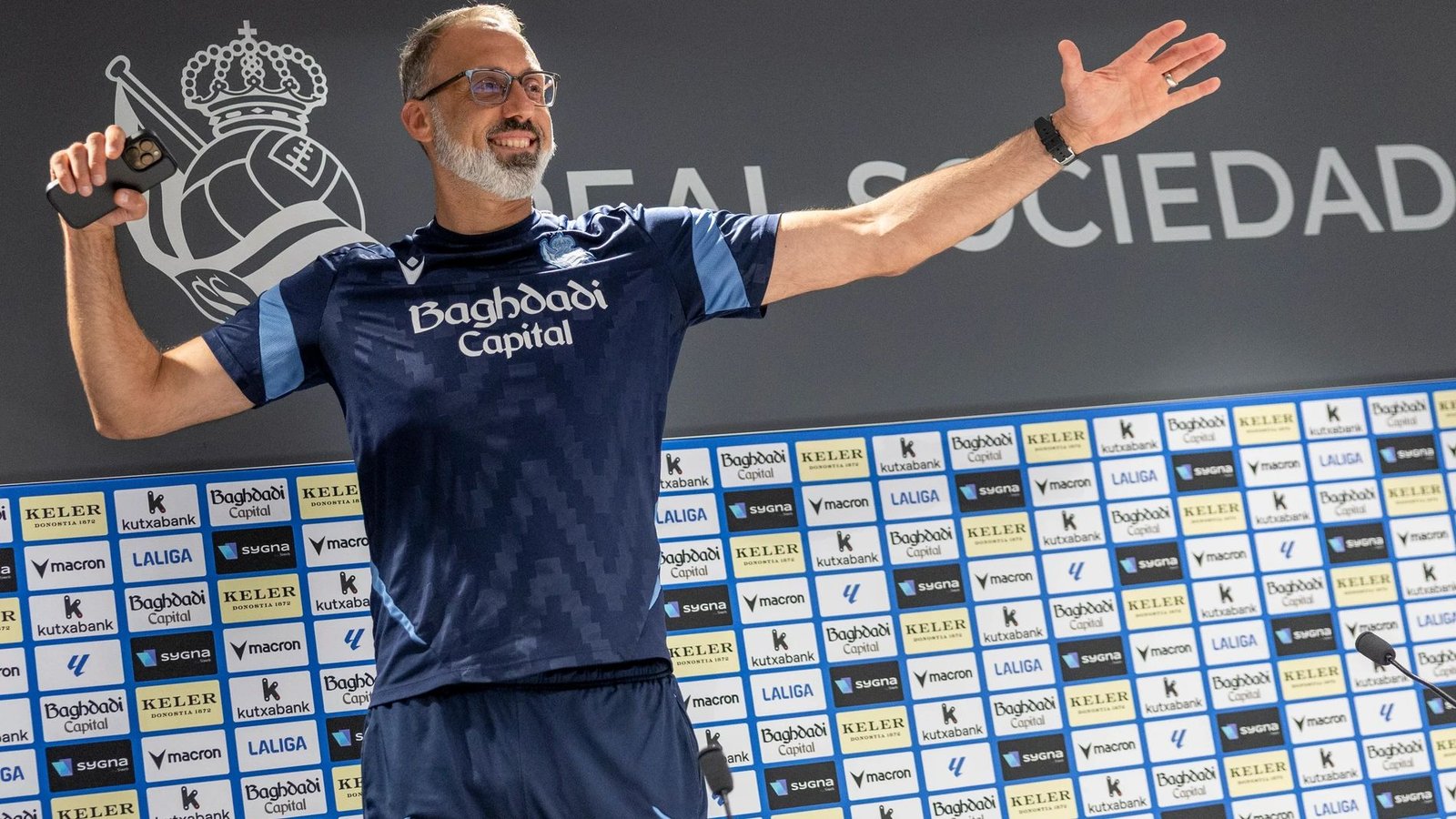
Enter Pellegrino Matarazzo. Born in New Jersey to Italian immigrants, Matarazzo is a Columbia University applied mathematics graduate who bypassed a potential career in finance on Wall Street to pursue a football career in the lower tiers of German football. He moved on to coaching after his playing career, studying alongside Julian Nagelsmann and joining Nagelsmann’s staff at Hoffenheim. Matarazzo quickly built his reputation as a head coach afterward, leading Stuttgart to promotion to the Bundesliga.
While headlines often focus on the ‘American coach succeeding in Spain,’ Matarazzo is fundamentally a product of the German system. He left the U.S. just as Major League Soccer and modern American football were taking their shape. As shown in the following interview with Sid Lowe, after decades abroad, he sounds more like a German who speaks great English than a New Jersey native.
Spanish football is conservative in its hiring decisions. It’s rare for top clubs like Real Sociedad to hire managers like Matarazzo with no La Liga experience. However, as the Premier League has shown over the last decade, there is significant value in bringing in coaches with fresh ideas into the local league.
The Impact of “Matarazzo-ball”
Matarazzo has successfully unlocked the directness that Francisco could not. This has been reflected across many different aspects. Matarazzo’s team keeps less possession and completes fewer passes per sequence than previous Real Sociedad teams. opting instead to load the box and accept defensive trade-offs.
Matarazzo seems to be finally aligning the team’s style of play with their squad. Alguacil’s Real Sociedad was more intense and duel-focused than they were given credit for, but they also had the players control possession and slow down games. With those players gone, Matarazzo must focus on a more ‘rock-and-roll’ approach that prioritises a more vertical and faster style over control.
This focus on directness, winning duels, and attacking the box more frequently seems to be solving the attacking issues that had haunted La Real for years. Even during the Alguacil era, it felt like la Real had to do a lot to earn a goal. Nowadays, goals come by more easily. According to Opta Analyst, Real Sociedad are sixth in expected goals (xG) created and fifth in goals scored. The direct style helps, but the team also benefits from a good scoring streak, converting chances at a higher rate than what their expected goals (xG) would suggest.
Matarazzo and this new style have also gotten the most out of players who were previously underperforming. Goncalo Guedes and Benat Turrientes are perhaps the best examples. After being mostly sidelined last season and under Sergio Francisco, Turrientes has become fundamental to Matarazzo-ball. He has shown that his defensive workrate is among the best in the league, and this has become foundational to the physical, direct style that Matarazzo wants to implement.
Meanwhile, Guedes has been enjoying his most prolific scoring season since 2022. He and Oyarzabal complement each other: while the captain operates outside the box and between the lines, Guedes takes advantage of the spaces created and makes runs into space. Matarazzo originally fielded them as a striker pair in a 4-4-2, but more recently Guedes has been playing closer to the left wing, leaving space in the center for a Luka Sucic, who is also enjoying the more direct style of play.
A New Chapter in Donostia
With a historic Copa del Rey trophy secured, the mission shifts to the home stretch: maintaining a top-seven finish and securing European football. While Matarazzo and his team have certainly benefitted from a classic new manager boost and are overperforming their xG, their underlying numbers are also those of a top-seven team. So, the team seems on track to achieve the objective of returning to Europe.
Even if that new manager boost fades away over time, his impact has helped the club avoid the transition trap for now. Just like La Real reaped benefits in the past from bolder player hires that were avoided by more conservative teams, they have now found similar success with a bolder coach hire. Let’s hope the rest of the league also learns from this lesson.

